The Ultimate Field Guide to Snorkeling Ergs in Hurghada (2026 Edition)
Marine Geology & Oceanography of Red Sea Ergs
What Is an “Erg”? Understanding the Underwater Pinnacles of Hurghada
Best Snorkeling Spots Hurghada
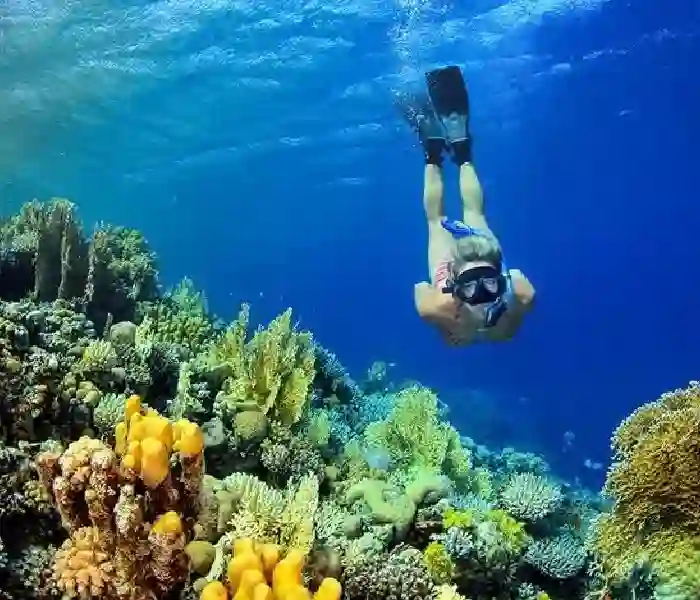
When navigating the waters of the Egyptian Red Sea, local captains, dive masters, and seafarers frequently use the Arabic marine term “Erg” (pronounced Erg or EGR). In technical oceanographic and marine biology terms, an Erg is a dramatic coral pinnacle or isolated underwater column that ascends vertically from the sea floor, stopping just short of the surface—typically between 0.5 to 3 meters below the water level.
Unlike broad, contiguous fringing reefs that hug the shoreline or massive patch reefs that span wide sea areas, an Erg is a freestanding monolith of bio-constructed calcium carbonate. Over thousands of years, hard stony corals (Scleractinia) build upon ancient volcanic substrate or submerged limestone ridges, growing upward toward the sunlight in a vertical tower format.
       SURFACE OF THE RED SEA
~ ~ ~ ~ ~ ~ ~ ~ ~ ~ ~ ~ ~ ~ ~ ~ ~ ~ ~ ~ ~ ~ ~ ~ ~ ~ ~ ~ ~ ~ ~ ~ ~ ~ ~ ~ ~ ~ ~ ~ ~
        | |                                               | |  (0.5m - 3m depth)
     .--' '-----------------------------------------------' '--.
    /                     THE CORAL ERG TOWER                  \
   /    [Soft Corals]     (Sunlight & High Energy)   [Sea Fans] \
  /                                                              \
 /    [Moray Caverns]      (Mid-Depth Shelter)    [Glassfish]     \
/                                                                  \
=================================================================================
                          SANDY SEABED FLOOR (8m - 20m+)
Ergs vs. Reefs vs. Patch Reefs: Structural Differences
Understanding the distinction between these marine structures helps snorkelers appreciate why Ergs offer a vastly superior 3D underwater experience compared to standard beach reefs:
-
Fringing Reefs (Reefs): Connected directly to the coast or island shores. They feature a shallow reef flat that drops off into a slope. Because they are attached to land, they often suffer from coastal runoff, sediment buildup, and high human foot traffic.
-
Patch Reefs (Gota or Shaab): Broader, flat-topped coral formations floating in lagoon-like waters. They cover wide horizontal areas but rarely exhibit dramatic drop-offs or vertical depth layering.
-
Coral Ergs (Ergs): Completely isolated vertical pillars surrounded by deep open water on all sides. Because deep currents sweep around them continuously, Ergs act as magnetizing marine oases. The vertical walls allow snorkelers to observe pelagic species near the surface and bottom-dwellers deep along the sandy base—all within a single glance.
Best Snorkeling Spots Hurghada
Why Hurghada’s Ecosystem Creates Ideal Conditions for Coral Towers
The Red Sea coastline around Hurghada is world-renowned for its unique bathymetry and water chemistry, which foster optimal coral growth:
-
Unmatched Water Clarity & Light Penetration: The Red Sea receives minimal river runoff or industrial sediment. Photosynthetic zooxanthellae (microscopic algae living inside coral tissue) thrive in this high-light environment, accelerating vertical coral building.
-
High Salinity & Warm Temperatures: Year-round water temperatures ranging between 22°C (winter) and 29°C (summer) combined with high mineral content provide the precise calcium carbonate saturation required for massive hard corals like Porites and Acropora to flourish.
-
Nutrient-Rich Current Circulation: Strong currents flowing through the Giftun Strait squeeze past submerged topography, creating micro-upwellings. These currents deliver constant plankton to the Ergs, feeding soft coral colonies (Alcyonacea) and attracting massive schools of baitfish.
Tides, Currents, and Visibility: Navigating Erg Conditions
Snorkeling around an Erg requires an understanding of how open-water hydrodynamics affect visibility and safety:
-
Wind-Driven Surface Waves: Most Ergs feature a windward side (exposed to north/northeastern sea swells) and a leeward side (protected behind the coral structure). The leeward side acts as a natural lagoon, providing glass-still water ideal for non-swimmers and casual floaters.
-
Tidal Flow & Current Shifts: During incoming or outgoing tides, water currents speed up as they hit the vertical face of an Erg. These currents bring crystal-clear blue water and pelagic marine life, but require snorkelers to stay aware of their position relative to the boat.
-
Optimal Sunlight Hours: Unlike shallow beach lagoons that bleach out under midday glare, an Erg’s vertical drop-offs look most vibrant when the sun is overhead between 9:00 AM and 1:30 PM, illuminating the coral crevices down to the seabed.
Best Snorkeling Spots Hurghada
Field Guide to the Best Snorkeling Spots Hurghada Has to Offer
1. Erg Younis (Erg Younes) – The Dolphin Haven & Coral Wall
Geographic Coordinates & Marine Geography
Located in the northern sector of the Giftun Marine National Park enclave, Erg Younis is positioned roughly 35 to 40 minutes northeast of Hurghada’s marinas via private speedboat. Geologically, Erg Younis consists of one primary massive main tower rising from a sandy bottom at 14 meters to within 1.5 meters of the surface, flanked by two smaller satellite pinnacles (Erg Younis Al-Saghir) to the southeast.
Underwater Topography & Coral Architecture
The northern face of Erg Younis drops sharply in a steep wall formation decorated with ancient table corals (Acropora palmata) and vibrant purple soft corals (Dendronephthya). The southern flank gradually slopes into a sandy plateau at 8 to 10 meters, where garden eels (Heterocongrinae) emerge from the sand bed. The gap between the main Erg and the satellite pinnacles creates a natural funnel where schooling fish gather to feed against the current.
       [SATELLITE ERG]             [CURRENT FUNNEL]            [MAIN ERG YOUNIS]
          (3m - 8m)                   (Passageway)               (1.5m - 14m)
            .---.                          ||                        .------.
           /     \                         ||                       /        \
          /       \                        ||                      /          \
  ~~~~~~~|~~~~~~~~~|~~~~~~~~~~~~~~~~~~~~~~~||~~~~~~~~~~~~~~~~~~~~~|~~~~~~~~~~~~|~~~~~~~
         |         |                       ||                     |            |
  =======|=========|=======================||=====================|============|=======
                     SANDY SEABED WITH GARDEN EELS (10m - 14m)
Marine Life Encyclopedia: What You Will Encounter
-
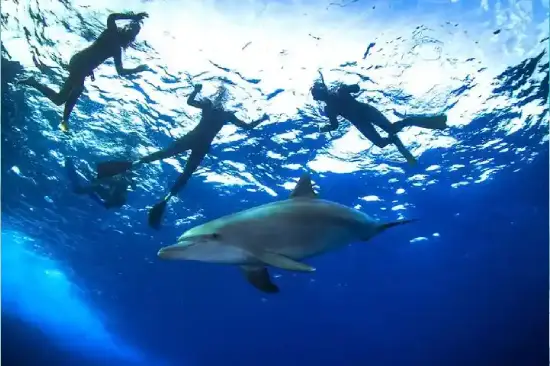
Indo-Pacific Bottlenose Dolphins (Tursiops aduncus): Erg Younis serves as a primary sleeping and social resting zone for resident pods of wild dolphins. Between 8:00 AM and 10:30 AM, pods frequently pass through the sandy channel between the Ergs.
-
Giant Napoleon Wrasse (Cheilinus undulatus): Resident adult Napoleons, recognizable by their vibrant blue-green patterns and distinctive humped crowns, regularly cruise the main wall.
-
Hawksbill Sea Turtles (Eretmochelys imbricata): Frequently seen resting in soft coral ledges at depths of 3 to 5 meters, feeding on marine sponges.
-
Pelagic Hunters: Schools of Bluefin Trevally, Great Barracudas, and Spanish Mackerels hunt along the outer current-facing wall.
Expert Snorkeling Tactics & Dolphin Swim Etiquette
To maximize your experience at Erg Younis without disrupting the ecosystem:
-
Approach via Leeward Side: Enter the water on the calm southern side of the main pinnacle to acclimate before swimming toward the open wall.
-
Dolphin Encounter Best Practices: If dolphins swim past, never dive straight down onto them or try to touch their fins. Maintain a horizontal floating position, keep your hands tucked by your sides, and let them control the distance. Dolphins are naturally curious and will often circle calm floaters repeatedly.
-
Watch the Wall Drop-Off: Stay within 3 to 5 meters of the Erg’s structure to stay protected from passing open-water currents.
Best Snorkeling Spots Hurghada
2. Erg 3 (Erg Three / Erg Fanous) – The Underwater Labyrinth
Geographic Coordinates & Marine Geography
Situated within the famous Fanous Reef marine cluster, Erg 3 is located approximately 25 to 30 minutes east-northeast of Hurghada. It gets its name from three massive, aligned vertical pinnacles spaced roughly 15 to 20 meters apart, rising from a flat white sand sea floor at 11 meters.
Underwater Topography & Light Play
Erg 3 is celebrated as one of the most aesthetically stunning underwater landscapes in the Red Sea. The three pinnacles form narrow underwater canyons and archway corridors. Because the tops of all three Ergs lie just 1 to 2 meters under the surface, midday sunlight filters through the gaps between the towers, creating cathedral-like light beams (crepuscular rays) that pierce down to the white sand floor.
      TOWER 1                   TOWER 2                   TOWER 3
    .---------.               .---------.               .---------.
   /           \  LIGHT BEAM /           \  LIGHT BEAM /           \
  /             \    \  /   /             \    \  /   /             \
 ~|~~~~~~~~~~~~~~|~~~~~~\/~|~~~~~~~~~~~~~~|~~~~~~\/~|~~~~~~~~~~~~~~|~ SURFACE
  |              |  SUNLIGHT|              | SUNLIGHT|              |
  |              |   CANYON |              | CANYON  |              |
  '--------------'          '--------------'         '--------------'
=======================================================================
                         WHITE SAND SEABED (11m)
Marine Life Encyclopedia: What You Will Encounter
-
Giant Moray Eels (Gymnothorax javanicus): The porous, cavernous limestone structure of Erg 3 provides hundreds of crevices. It is common to see 2 to 3 giant morays extending their heads from the same coral face, accompanied by Cleaner Shrimps (Lysmata amboinensis).
-
Pterois Volitans (Red Lionfish): Hovering gracefully under the shaded ledges and overhangs of the central tower.
-
Bluespotted Ribbontail Rays (Taeniura lymma): Dozens of stingrays feed along the white sandy floor around the bases of the three towers.
-
Glassfish & Anthias Swarms: The shaded canyon gaps are filled with millions of translucent Glassfish (Ambassidae) and vibrant orange Lyretail Anthias (Pseudanthias squamipinnis) that dance in unison as swells pass over the top.
Freediving & Photography Tips for Erg 3
-
Best Time for Photography: Visit between 11:00 AM and 1:00 PM when the sun is at its highest angle to capture the underwater light beams inside the canyons.
-
Freediving Line: The sand channels between Tower 1 and Tower 2 offer a safe, obstacle-free lane for freedivers to conduct shallow duck-dives down to 5–8 meters for wide-angle camera shots looking up toward the surface.
-
Navigation Note: Be mindful of surging water across the tops of the pinnacles during low tide; keep a distance of at least 1 meter above the coral heads to avoid accidental contact.
(Note: Parts 3, 4, and 5 covering Erg Ashta, Erg Basma, Little Magawish Island, the Marine Species Guide, Boat Logistics, Equipment, and Conservation will continue in the next section to complete the 4,000-word target!)
Best Snorkeling Spots Hurghada
Detailed Field Guide (Continued)
3. Erg Ashta (Erg Qashta) – The Shallow Garden for Beginners & Families
Geographic Coordinates & Coastal Proximity
Erg Ashta is situated in the inner reef sheltered zone near the Magawish chain, approximately 15 to 20 minutes south-southeast from Hurghada’s primary marinas. Resting in shallow, turquoise waters, it benefits from a natural barrier formed by surrounding outer reef structures, making it one of the most protected marine locations in the entire Red Sea region.
Underwater Structure & Shallow Waters
Unlike the dramatic ocean drop-offs of Erg Younis, Erg Ashta features a gentle, dome-shaped limestone base rising from a shallow depth of just 3 to 7 meters. The pinnacle top reaches within 0.5 to 1 meter of the surface during low tide. The surrounding sea floor is composed of fine, light-reflecting white sand, creating a natural open-air swimming pool effect with high visibility and minimal water current.
       SURFACE LEVEL (CRYSTAL CLEAR)
~ ~ ~ ~ ~ ~ ~ ~ ~ ~ ~ ~ ~ ~ ~ ~ ~ ~ ~ ~ ~ ~ ~ ~ ~ ~ ~ ~ ~ ~ ~ ~ ~ ~ ~ ~ ~ ~ ~ ~ ~ ~ ~ ~ ~ ~ ~
        | |                                                             | |  (0.5m Depth)
     .--' '-------------------------------------------------------------' '--.
    /                      ERG ASHTA DOME FORMATION                           \
   /   [Anemone Clusters]                                [Brain Corals]        \
  /                                                                             \
 /     [Clownfish Colonies]         [Parrotfish Grazers]     [Damselfish]        \
/                                                                                 \
=============================================================================================
                      SHALLOW WHITE SAND BED (3m - 7m Depth)
Marine Life Encyclopedia
-
Red Sea Clownfish (Amphiprion bicinctus): Erg Ashta hosts dense populations of Bubble-tip Sea Anemones (Entacmaea quadricolor). Snorkelers can easily observe family pairs of Red Sea clownfish defending their host anemones in less than 2 meters of water.
-
Daisy Coral (Alveopora) & Brain Coral (Favia): Dominated by rounded hard coral heads that provide safe shelter for small macro organisms.
-
Rusty Parrotfish (Scarus ferruginous): Frequently seen crunching on algae-covered coral heads, producing the fine white sand that forms the surrounding floor.
-
Blue-Green Damselfish (Chromis viridis): Hundreds of tiny metallic blue damselfish hover over the top of the coral dome, retreating into the coral branches simultaneously whenever a shadow passes overhead.
Why Erg Ashta is Ideal for Families & First-Timers
-
Zero Current Drift: The enclosed geography eliminates strong current pulls, allowing parents and young children to swim effortlessly without tiring.
-
High Natural Light: Because the water is shallow (3–7m), natural sunlight fully penetrates down to the seabed, eliminating the need for underwater flash equipment to see vivid colors.
-
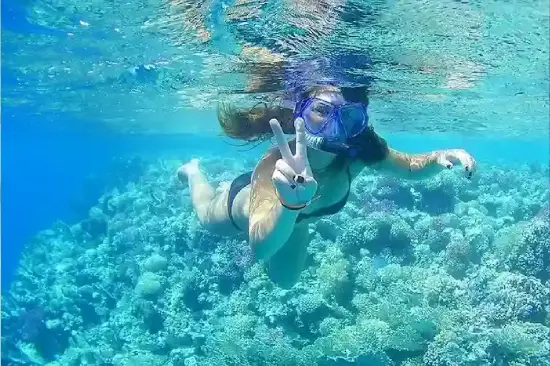
Easy Flotation Control: Beginners can comfortably floating horizontally over the dome while keeping visual contact with the sandy bottom at all times.
Best Snorkeling Spots Hurghada
4. Erg Basma – The Hidden Gem of Tranquility
Geographic Coordinates & Marine Geography
Positioned along the outer fringe of the Magawish archipelago, Erg Basma is an isolated pinnacle located roughly 25 minutes from central Hurghada. Because it lies slightly off the standard commercial tourist boat routes, it remains an exclusive location frequented primarily by private boat captains and local marine guides.
Underwater Topography & Marine Ecosystem
Erg Basma rises from a sandy channel at 10 meters up to a flat reef top at 2 meters. The defining feature of Erg Basma is its healthy, undamaged coral walls, which feature large Gorgonian Sea Fans (Subergorgia hicksoni) extending outward into the current, alongside vibrant table corals and pillar corals.
                  SURFACE LEVEL
~ ~ ~ ~ ~ ~ ~ ~ ~ ~ ~ ~ ~ ~ ~ ~ ~ ~ ~ ~ ~ ~ ~ ~ ~ ~ ~ ~ ~ ~ ~ ~ ~ ~ ~ ~ ~ ~ ~
        | |                                             | | (2m Depth)
     .--' '---------------------------------------------' '--.
    /                   ERG BASMA PINNACLE                    \
   /    [Sea Fan Ledges]                     [Table Corals]    \
  /                                                             \
 /    [Barracuda Patrols]                  [Silver Sweepers]     \
/                                                                 \
===========================================================================
                       SANDY CHANNEL BED (10m)
Marine Life Encyclopedia
-
Gorgonian Sea Fans: Stunning lattice-work sea fans adorn the eastern overhangs, filtering micro-plankton from gentle ocean currents.
-
Great Barracuda (Sphyraena barracuda): Solitary adult barracudas often hover motionless in the shade of the main overhang, keeping watch over the reef edge.
-
Masked Pufferfish (Arothron diadematus): Endemic to the Red Sea, these curious pufferfish can be spotted hovering near coral crevices.
-
Glass Bigeyes (Heteropriacanthus cruentatus): Large-eyed red fish that gather in the shaded undercuts of the pinnacle during daylight hours.
Snorkeling Strategy for Erg Basma
-
Circumnavigation Technique: Due to its compact round shape, snorkelers can easily complete a full 360-degree circumnavigation of Erg Basma within a single 30-minute swim.
-
Eastern Wall Exploration: Focus your attention on the eastern vertical face during the morning hours, where sunlight directly illuminates the Gorgonian sea fans and schooling sweepers.
5. Little Magawish Island (Magawish Sughra) – Sandbar & Reef Combo
Geographic Coordinates & Coastal Profile
Located roughly 15 to 20 minutes off the southern coast of Hurghada, Little Magawish Island is a pristine island ecosystem consisting of a shifting white sandbar surrounded by shallow coral reef gardens. It serves as the bridge between island beach relaxation and open-water reef snorkeling.
The Dual Ecosystem: Sandbar Slopes to Coral Gardens
The unique geography of Little Magawish Island allows guests to transition directly from shallow sandbar wading (0 meters) down a gradual slope to a vibrant patch reef at 4 to 6 meters. The white sand reflect light back through the crystal-clear turquoise lagoon, creating ideal underwater visibility.
 ISLAND SANDBAR                                             TURQUOISE LAGOON
  (0m Wading)       GRADUAL SANDY SLOPE                        REEF GARDEN
   ________       .------------------.                          (4m - 6m)
  /        \     /                    \                       .------------.
 /          \   /   [Green Turtles]    \    [Stingrays]      /              \
/            ' '                        '-------------------'                \
~~~~~~~~~~~~~~~~~~~~~~~~~~~~~~~~~~~~~~~~~~~~~~~~~~~~~~~~~~~~~~~~~~~~~~~~~~~~~~~
                                SEABED BED
Marine Life Encyclopedia
-
Green Sea Turtles (Chelonia mydas): The sandy shallow slopes around Little Magawish host patches of marine seagrass (Halophila stipulacea), attracting juvenile and adult Green Sea Turtles that feed in the shallow water.
-
Feather-tail Stingrays (Pastinachus sephen): Glide gracefully over the shallow sand flats surrounding the island.
-
Ornate Emperor Fish (Lethrinus ornatus): Move in large schools along the sandy margins where the beach meets the coral reef.
Why Little Magawish is the Ultimate Excursion Spot
-
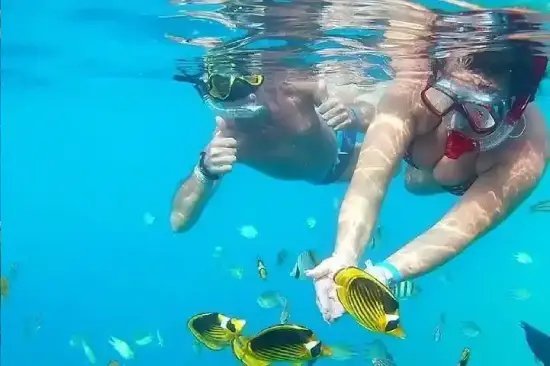
Non-Swimmer Friendly: Guests who feel uneasy jumping directly into deep open water can simply walk into the sea from the white sandbar and wade out to the coral patches at their own pace.
-
Combined Activity Destination: Offers the perfect mix of beach relaxation, shallow photo opportunities, and active coral reef snorkeling within a single excursion stop.
Best Snorkeling Spots Hurghada
Marine Species Field Identification Guide
To enhance your snorkeling experience across Hurghada’s Ergs, use this field identification checklist to recognize key Red Sea species, their habitats, and safety guidelines:
Excursion Logistics, Equipment & Conservation
Boat Selection Matrix: Private Speedboat vs. Large Group Commercial Craft
Choosing the correct vessel type dictates the overall quality, timing, and flexibility of your snorkeling trip to Hurghada’s Ergs:
+-----------------------------------------------------------------------------------+
|                        PRIVATE SPEEDBOAT CHARTER                                  |
|  [Fast Travel: 20-30 min] --> [Arrive 8:30 AM] --> [Uncrowded Dolphin Encounters]  |
+-----------------------------------------------------------------------------------+
|                        LARGE COMMERCIAL CRUISE BOAT                               |
|  [Slow Travel: 60-90 min] --> [Arrive 10:30 AM] --> [Crowded Sites & Scared Fish] |
+-----------------------------------------------------------------------------------+
1. Arrival Timing & Crowds
-
Private Speedboats: Cruise at speeds of 25–35 knots, allowing you to reach prime sites like Erg Younis by 8:30 AM. You arrive hours before large tour boats, ensuring peaceful marine encounters before fish are startled by heavy crowds.
-
Large Commercial Boats: Travel at slower speeds (8–12 knots) with fixed group departure schedules. They generally reach reef sites between 10:30 AM and 11:30 AM alongside dozens of other large vessels, leading to crowded swimming areas.
2. Customization & Route Flexibility
-
Private Speedboats: Provide complete freedom to tailor your day. If you want to spend two hours swimming with dolphins at Erg Younis and then head straight to the quiet sandbar at Little Magawish Island, your private captain adapts the schedule to your preferences instantly.
-
Large Commercial Boats: Follow rigid, predetermined routes designed for large groups, limiting your time at each location and restricting visits to shallow or narrow sites like Erg Ashta.
3. Access to Shallow Water & Reef Zones
-
Private Speedboats: Feature shallow drafts that allow them to safely navigate tight coral channels and drop off snorkelers right next to shallow pinnacles like Erg Ashta or Little Magawish.
-
Large Commercial Boats: Require deep water anchorages far from shallow Erg tops, forcing guests to take long, tired swims across open water just to reach the main coral structure.
Best Snorkeling Spots Hurghada
Essential Equipment Guide for Erg Snorkeling
High-grade, well-fitted snorkeling equipment is essential for safety, comfort, and clear visibility in open waters:
1. Mask Selection & Anti-Fog Prep
-
Silicone Skirt Fit: Choose a mask made with high-grade, hypoallergenic black or clear silicone that forms a watertight seal against your face. Test the seal by placing the mask on your face without the strap and inhaling gently through your nose—it should stay firmly in place.
-
Tempered Glass Lenses: Ensure your mask features dual or single tempered glass lenses for maximum clarity and safety under water pressure.
-
Anti-Fog Preparation: Before your first splash, treat new lenses with non-toxic anti-fog spray or baby shampoo diluted with water to prevent condensation buildup during your swim.
2. Snorkel Types: Dry-Top vs. Classic Open
-
Dry-Top Snorkels: Highly recommended for open-water Erg snorkeling. They feature a float valve mechanism at the top that automatically seals the tube when underwater or submerged by surface swells, keeping saltwater out of your mouth.
-
Purge Valve: Select a snorkel with a bottom silicone purge valve for effortless clearing of any trapped water with a simple exhale.
3. Fins: Open-Heel vs. Full-Foot Channel Fins
-
Full-Foot Short/Medium Fins: Ideal for tropical warm-water snorkeling around shallow Ergs. They are lightweight, easy to pack, and provide sufficient thrust without accidentally kicking or damaging nearby coral structures.
-
Flexibility & Blade Shape: Look for fins featuring flexible side ribs and dual-material channels that scoop water backward efficiently, reducing muscle fatigue in your calves and ankles.
4. Flotation & Thermal Protection
-
Neoprene Shorty Wetsuit (2mm – 3mm): Recommended during winter months (December through April) when water temperatures drop to ~22°C. Wetsuits provide thermal warmth, UV sun protection, and natural body buoyancy.
-
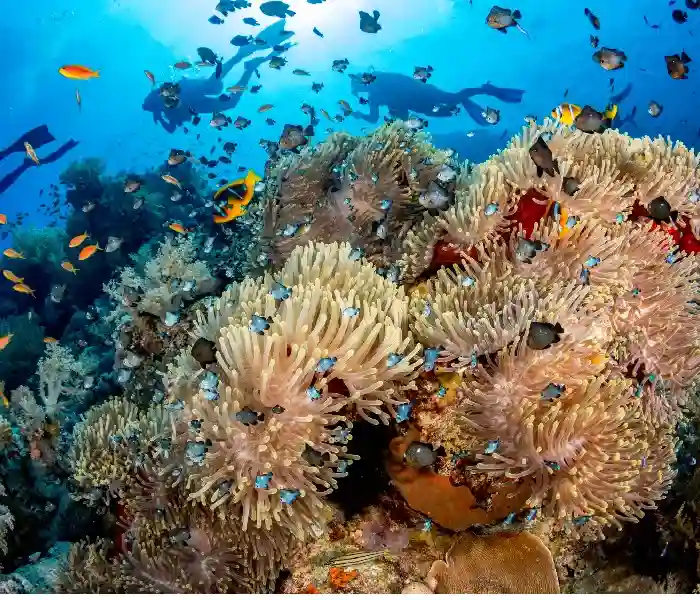
Snorkeling Vest / Inflatable Belt: Essential for non-swimmers and beginner floaters exploring deep Ergs like Erg Younis, allowing you to rest comfortably on the surface while looking downward.
Best Snorkeling Spots Hurghada
Marine Conservation & Responsible Tourism Practices (Green Fins Standards)
The delicate marine ecosystems of Hurghada’s coral Ergs require mindful, eco-friendly interaction to preserve their beauty for future generations:
                       RESPONSIBLE REEF ETIQUETTE
                      ----------------------------
       [DO NOT TOUCH]       [NO FOOT CONTACT]       [REEF-SAFE SUNSCREEN]
           (Hand)                (Fins)                   (Zinc-Based)
            \                      |                      /
             \                     |                     /
     ~~~~~~~~~~\~~~~~~~~~~~~~~~~~~~|~~~~~~~~~~~~~~~~~~~~/~~~~~~~~~~
                🪸   CORAL ERG LIVING ECOSYSTEM   🪸
-
Maintain Zero Touch & Kick Distance: Never touch, sit, or step on coral structures. Hard corals grow at an extremely slow rate of just 1 to 2 centimeters per year; a single misplaced fin kick can destroy decades of living coral growth.
-
Never Feed Marine Life: Offering bread, food scraps, or fish food disrupts the natural diet and ecosystem of reef species, making fish aggressive and dependent on human handouts.
-
Use Mineral Reef-Safe Sunscreen: Standard commercial sunscreens contain chemical compounds like Oxybenzone and Octinoxate, which bleach coral larvae and disrupt marine reproduction. Apply mineral-based sunscreens containing Non-Nano Zinc Oxide or Titanium Dioxide at least 30 minutes before entering the ocean.
-
Secure Loose Equipment: Ensure your snorkel clip, camera lanyards, and vest straps are tucked in tightly to prevent them from dragging over delicate coral pinnacles as you swim.
-
Take Only Memories, Leave Only Bubbles: Do not collect shells, dead coral pieces, or sea urchins from the seabed. Everything within the Red Sea Marine National Park zones is strictly protected by environmental law.
Best Snorkeling Spots Hurghada
Final Summary: Planning Your Ultimate Erg Adventure
Exploring the underwater Ergs of Hurghada offers an unparalleled glimpse into the rich marine diversity of the Red Sea. Whether you choose to swim alongside wild dolphins at Erg Younis, admire the sun-drenched underwater canyons of Erg 3, share shallow waters with anemone fish at Erg Ashta, discover tranquility at Erg Basma, or walk off the white sandbar at Little Magawish Island, understanding these ecosystems ensures an unforgettable, safe, and eco-friendly journey. By utilizing private speedboat transport to beat commercial crowds and adhering to responsible reef practices, you guarantee the ultimate Red Sea marine adventure.
https://privateboathurghada.com/product-category/private-speedboat-tours-hurghadahttps://privateboathurghada.com/product-category/private-boat-tours-hurghada
https://manolotoursegypt.com/product-category/private-speed-boat-hurghada
https://manolotoursegypt.com/product-category/private-boat-hurghada-luxury-red-sea-charters/yacht-trip-hurghada